

What hurts?
Some possible conditions • Ankle Pain – Ankle – Outside
-
 Sprain/Strain
 -
 Arthritis
 -
 Sinus Tarsi Syndrome
Some possible conditions • Ankle Pain – Ankle – Outside
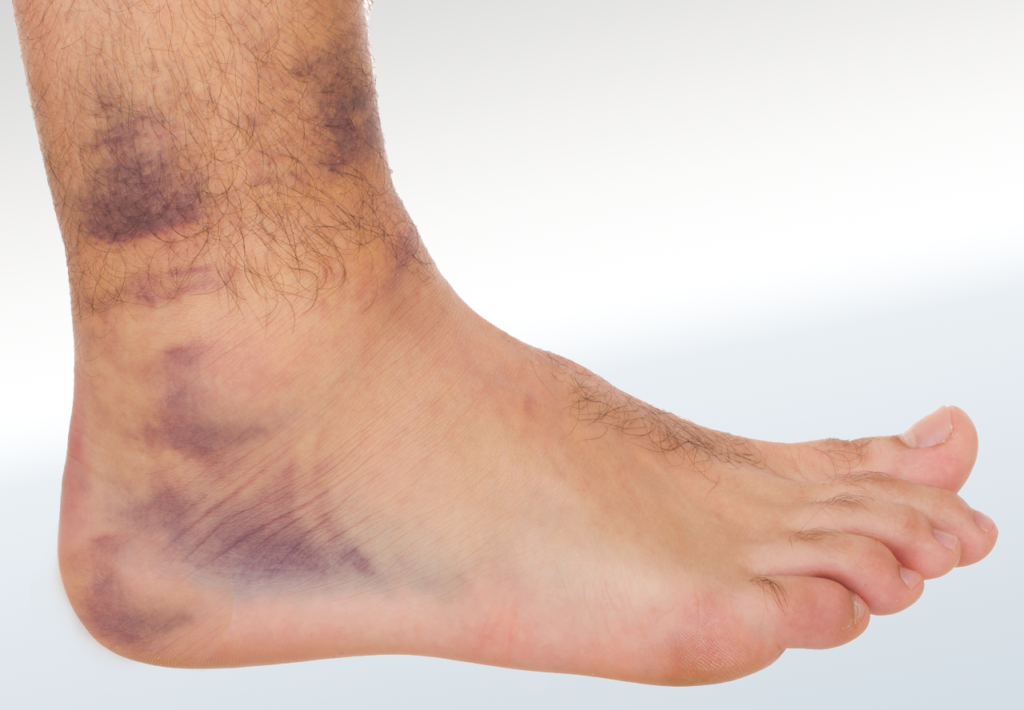
Ankle sprains and strains have similar symptoms, causes and risk factors, but they also have some differences. Ankle sprains are usually a result of a traumatic or acute injury, while ankle strains can be acute or chronic. Acute injuries of the ankle occur suddenly and are caused by a single episode, whereas a chronic injury tends to develop after a period of time with repetitive movement or overuse. The ankle joint is formed by the tibia in the lower leg and the talus bone in the foot. There are dozens of ligaments to support the ankle and several muscles and tendons to provide strength and stability. If any of the ligaments are overstretched or disrupted, an ankle sprain may result. When the muscles or tendons are affected, a strain can occur.
The main difference between a sprain and strain is the onset of the pain, swelling, redness and reduced range of motion at the ankle. When an ankle sprain occurs, there may be an audible pop or a popping feeling, followed by bruising at the site and intense pain at the time of the injury. A strain will typically occur over time and can also result in weakness and instability around the ankle joint. A strain can also occur from a one-time injury or possibly at the same time as a sprain. Sprains and strains are graded from 1 to 3 and based on severity. Severity ranges from minor tearing to complete tearing of the soft tissues. Symptoms will be worse the higher the grade.
Ankle sprains and strains have similar risk factors including overtraining causing ligament or muscle fatigue, poor athletic conditioning, being overweight, not warming up sufficiently before training, poor and unsupportive footwear and history of a previous ankle injury. Another ankle injury is much more likely to occur after it has already been injured due to a sprain or strain. Additionally, women over the age of 30 and young men between the ages of 15 and 24 tend to be more at risk for ankle sprains. Activities and sports carried out on uneven terrain or involving pivoting on the spot or side-to-side movement may also increase a person’s risk for injury at the ankle.
Healing after an ankle sprain can be lengthy as ligaments have little to no blood supply and knowing if ankle pain is a result of a sprain or strain is imperative for proper treatment and avoiding re-injury. Mild ankle sprains and strains can be treated at home with R.I.C.E, the age old application of rest, ice, compression and elevation. Ankle joint instability is common after injury. Ankle braces and taping can be effective for increasing stability, as are custom foot orthotics and appropriate footwear. Stretching and strengthening exercises will help to support and stabilise the weakened ankle joint. More severe injuries may also require immobilisation of the joint with traditional plaster casts or an air cast/boot. Surgery to repair the injured structures is only required if the first-line of treatment and rehabilitation is ineffective.
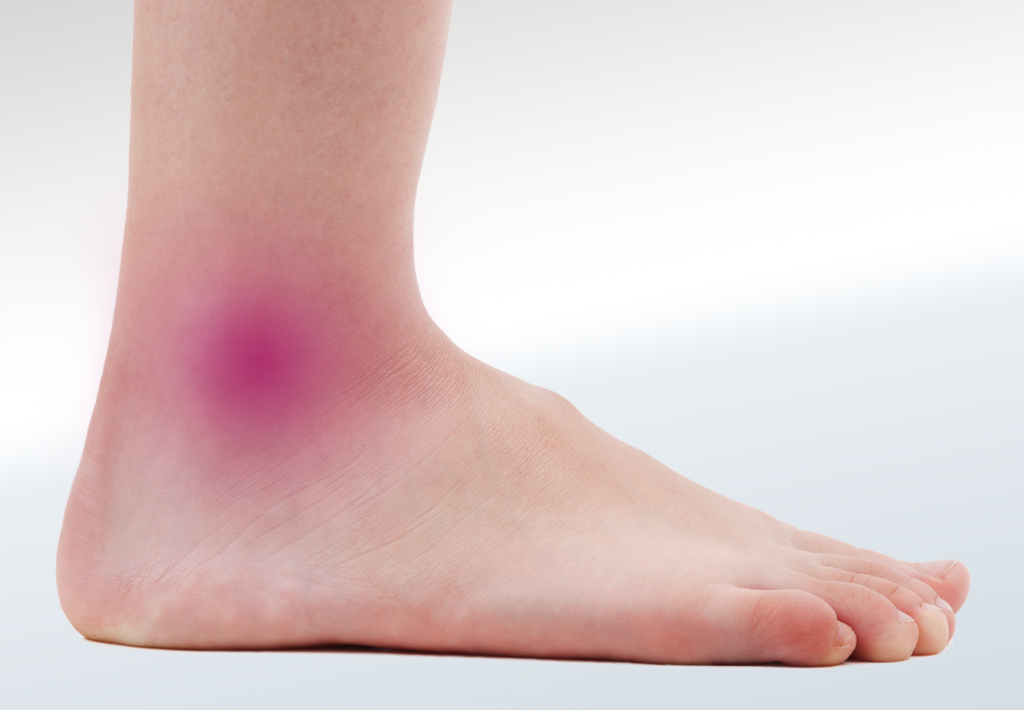
Arthritis is a common inflammatory condition that affects bony joints. The most common type of arthritis is Osteoarthritis (OA). It occurs when the cartilage, which acts as a cushion between the bones of the lower limb wears down over time. As the cartilage deteriorates, the bones begin to rub against each other causing pain and inflammation. While it is most common in older adults, osteoarthritis can occur at a younger age. Other types of ankle joint disease/arthritis include gout, septic arthritis and charcot.
The most common symptom of ankle arthritis is pain, which can range from mild to severe. Along with pain, people with ankle arthritis may also experience stiffness, as well as decreased range of motion or a change in ankle alignment. These symptoms may be worse after sitting or standing for long periods of time, or with physical activity. Gout can be acute or chronic, but when it first presents, pain, swelling and redness of the joint are the primary indicators. These are also the same symptoms you would find with septic arthritis, which indicates an infected joint. Any quick onset joint redness, or swelling needs to be investigated immediately.
Osteoarthritis is caused by a combination of genetic and environmental factors. With age comes the natural breakdown of the cartilage. Biomechanics plays a significant role in the development of osteoarthritis because of the daily wear and tear on our ankle joint and bearing the weight of the body daily in walking or activities. Previous ankle injuries or surgeries can cause damage to overall joint structure/cartilage, which can be another factor. Overuse of the joint (e.g. avid gymnast or runner) is another cause of ankle osteoarthritis as the more we work our joints, the faster cartilage breaks down. This is why jobs that involve a lot of walking and kneeling will have higher rates of workers with osteoarthritis. Gout is primarily precipitated by diet but ultimately, is a by-product of faulty handling or producing of uric acid by the body. These crystals build up within a joint and are very painful. Septic arthritis is caused by an infectious agent being introduced into/seeding the joint space. Finally, charcot neuro-arthropathy is a joint disease in individuals with neuropathy, and most typically diabetes. The exact cause is largely inconclusive.
Treatment for ankle arthritis begins with non-surgical approaches, such as medication, physical therapy, weight loss, bracing/splinting, orthotics and well-fitted shoes. Physical therapy can help to reduce pain and improve function by strengthening the muscles around the joints. Weight loss is also an important aspect of treatment as it can help to reduce the pressure on the ankle joints. Often a brace, splint, orthotic or shoe with a forefoot rocker may be recommended to offer support and aid in pain reduction and improve range-of-motion.
Sinus tarsi syndrome is a rare injury to the subtalar joint, the joint just below the ankle joint. The sinus tarsi is a tunnel or opening between the talus and calcaneus, the two bones in the foot that make up the subtalar joint. Several ligaments, nerves and blood vessels pass through the sinus tarsi. When any of these structures becomes injured, sinus tarsi syndrome may result. If the normal position and function of the subtalar joint is disrupted, the sinus tarsi tunnel will be affected and can result in pain and discomfort. The subtalar joint and the sinus tarsi also play an important role in proprioception. Proprioception is the awareness of the body in space and goes hand-in-hand with balance and stability.
Pain on the outside of the foot that is difficult to pinpoint can be indicative of sinus tarsi syndrome. The area of pain is similar to that of an ankle sprain and often occurs in conjunction with a traumatic sprain of the ankle joint. The ankle and foot may feel stiff in the morning when first waking and improve as the day progresses. Pain associated with sinus tarsi syndrome typically develops over a period of time, not suddenly. In other words, if an ankle sprain does not seem to fully heal or continues to be problematic, it may be due to a resultant sinus tarsi syndrome caused by the initial ankle sprain itself.
Pain due to sinus tarsi syndrome can be caused by a traumatic injury or from overuse. An injury to the sinus tarsi following a traumatic ankle sprain can cause synovitis, which is an inflammation of the synovial lining of the joint. It can also cause permeation of fibrous scar tissue into the joint. If sinus tarsi syndrome is due to overuse caused by repetitive walking or standing, or overpronation of the foot, the subtalar joint will be abnormally positioned causing issues with balance and instability during gait. A pronated subtalar joint causes compression of the two bones of this joint, and if they make contact with one another, arthritis and pain will result.
Early treatment and intervention is crucial to prevent long term pain and discomfort. Rest and modification of the activities that aggravate the symptoms of sinus tarsi syndrome will help to relieve the pain and discomfort. To control instability, ankle braces and taping are effective in restricting the movement at the subtalar joint. Custom foot orthotics support and lift the arch of the foot, opening up the sinus tarsi to reduce compression. Footwear that is designed to control pronation and increase stability is an important component of treatment. Surgical treatment is a last resort for chronic pain from sinus tarsi syndrome. If this syndrome is a result of severe flat feet and range of motion at the subtalar joint is limited, surgery may be required to reconstruct the foot and arch and reduce the compression within the sinus tarsi.


